Jump To
Text Size
Page
—
of 20
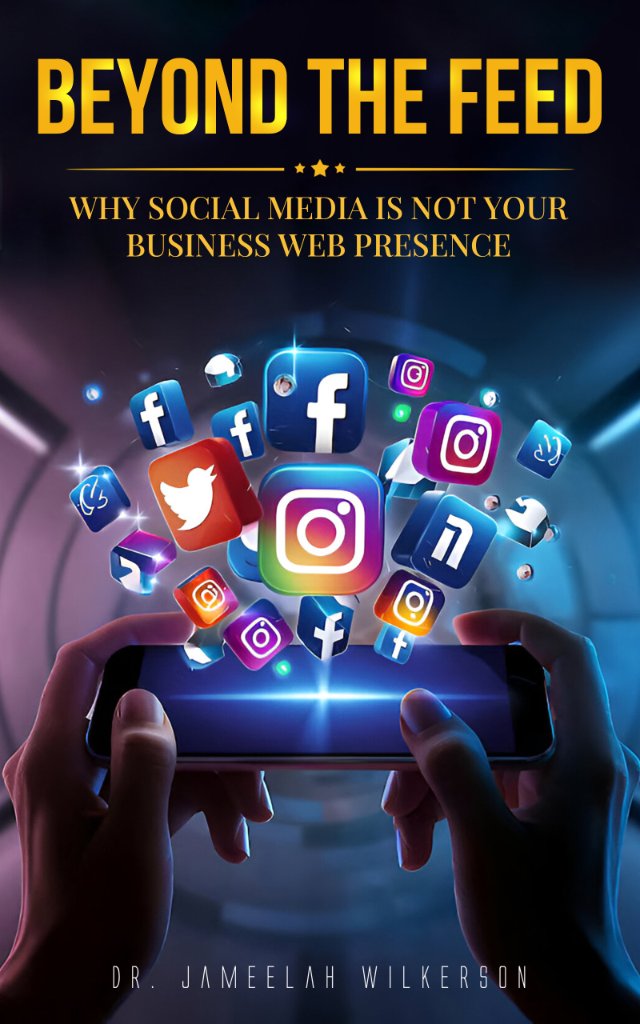
BeyondThe Feed
Why Social Media Is Not Your Business's Web Presence
Dr. Jameelah "Just Jay" Wilkerson
Copyright
© 2026 Dr. Jameelah "Just Jay" Wilkerson
Published by ImJustJay.com · The Hype Magazine Media Group
All rights reserved. No part of this publication may be reproduced without prior written permission.
Printed in the United States of America.
Contents
Table of Contents
The Illusion of Visibility
Rented Land vs Owned Assets
The Algorithm Trap
Building Your Digital Foundation
Turning Attention Into Ownership
Controlling Your Digital Narrative
Build It Like You Own It

Chapter One
The Illusionof Visibility
Visibility is not ownership, and attention is not control
The Visibility Trap
Social media creates a powerful illusion. It makes it feel like your business is constantly being seen, supported, and engaged with. The likes, comments, shares, and views give the impression that you are building something meaningful and growing in real time. But visibility does not equal ownership, and attention does not guarantee stability. You can have a post reach thousands today and struggle to reach even a fraction of that audience tomorrow. That inconsistency is not by accident — it is by design.
The reality is that social media platforms are not built to serve your business. They are built to serve themselves. Your content, your time, and your audience all contribute to their growth, not yours. You are participating in an ecosystem where you have limited control over distribution, access, and long-term reach. Even the people who follow you are not truly yours — you cannot directly reach them without going through the platform's filters. This means your business is operating on borrowed access, not owned relationships.
When your entire presence depends on social media, your business becomes fragile. A change in the algorithm, a policy update, or even a temporary account issue can disrupt everything you've built. What looks like a strong digital presence is often just surface-level exposure without a solid foundation underneath it. Without ownership, there is no security — and without security, there is no true growth.
"You can go viral today and be invisible tomorrow. That's not a business strategy."
4

Chapter Two
Rented Landvs Owned Assets
Stop building your empire on land you don't own
Ownership Changes Everything
Relying only on social media to build your business is the equivalent of building on rented land. You can invest time, energy, and creativity into growing your presence, but at the end of the day, you do not control the space you are building on. The platform sets the rules, controls visibility, and ultimately decides how and when your audience can interact with you. At any moment, your reach can be limited, your content can be removed, or your account can be restricted — without warning and without recourse.
Owned assets shift the power back into your hands. These are the pieces of your business that you fully control, such as your website, your email list, your customer database, and your digital products. Unlike social media, these assets allow you to communicate directly with your audience, present your brand exactly how you choose, and create consistent pathways for revenue. There is no algorithm deciding who gets access — you control the experience from start to finish.
When you build on owned platforms, you are no longer dependent — you are positioned. Your website becomes your headquarters, your email list becomes your direct line of communication, and your systems become predictable and scalable. Social media should support your business, not sustain it. The goal is to use platforms to drive attention, but always bring that attention back to something you own. That is where real growth happens, and that is how you build something that lasts.
"Ownership creates stability. Control creates longevity."
6
Your Owned Digital Assets
Your Website
Your headquarters. Always accessible, always working, always aligned with your goals.
Your Email List
Your direct line to your audience — no algorithm can block it.
Your Customer Database
Owned data that powers personalized communication and repeat revenue.
Your Digital Products
Courses, guides, downloads — income streams you fully control.
Your Content Hub
A blog, podcast, or video library that lives on your own platform.
7

Chapter Three
The AlgorithmTrap
The algorithm is not your friend — it's a filter
How the Algorithm Controls You
The algorithm is one of the most misunderstood forces in modern business. Many believe that if they post consistently, follow trends, and engage enough, they can "beat" it. But the truth is, the algorithm is not designed for your success — it is designed to keep users on the platform for as long as possible. That means your content is only valuable as long as it serves the platform's goals, not your business objectives.
This creates a cycle that many entrepreneurs unknowingly fall into. You begin by sharing your message, your products, and your vision. But over time, you start adjusting your content to chase engagement. You post what gets likes instead of what builds your business. You follow trends instead of setting direction. You become reactive, constantly trying to stay visible instead of building something stable. In this cycle, your strategy slowly disappears, replaced by short-term tactics that don't create long-term value.
The deeper issue is that the algorithm controls your access to your own audience. Even people who intentionally follow you may never see your content. Your reach becomes inconsistent, unpredictable, and outside of your control. This forces you to work harder for diminishing returns, constantly producing content just to maintain a presence. A real business cannot rely on something so unstable. True growth comes from systems you control, not systems that control you.
"Your business becomes reactive instead of intentional — and that's the trap."
9

Chapter Four
Building YourDigital Foundation
A real online presence starts with a foundation you control
Your Website Is Your Headquarters
A real online business is built on a foundation that you own and control. Your website is not just a digital placeholder — it is your headquarters. It is the one place where your brand lives without interference, where your message is clear, and where your audience can fully experience what you offer. Unlike social media, your website does not rely on an algorithm to determine visibility. It is always accessible, always working, and always aligned with your goals.
Building a strong digital foundation means creating structure and intention behind your presence. Your website should guide visitors through a clear journey — from discovering who you are, to understanding your value, to taking action. This includes having a strong brand message, organized content, lead capture systems, and clear offers. Every part of your platform should work together to turn attention into opportunity and opportunity into revenue.
When your foundation is solid, everything changes. Social media becomes a tool, not a dependency. Instead of trying to convert people within a platform you don't control, you direct them to a space where you do. This allows you to build relationships, collect data, and create consistent income streams without relying on external systems. A strong foundation gives your business stability, scalability, and long-term power — and that is what separates presence from real positioning.
"Your website is not just a page — it's a system that guides people from Discovery → Trust → Action."
11
Building a Strong Digital Foundation
Clear Brand Message
Visitors should immediately understand who you are and what you offer.
Structured User Journey
Guide your audience from discovery to understanding to action.
Lead Capture System
Capture email addresses and build your list from every visit.
Revenue Conversion Path
Every page should have a clear next step that moves toward a sale.
Content That Works 24/7
Your website works while you sleep — build it to convert, not just exist.
12

Chapter Five
Turning AttentionInto Ownership
If you can't reach them outside the platform, the attention is lost
Build Infrastructure, Not Just Awareness
Attention is easy to get but difficult to keep. Social media is designed to generate quick bursts of visibility, but that visibility disappears just as fast as it comes. The real goal is not just to attract attention — it is to capture it and convert it into something you own. If someone engages with your content but you have no way to reach them outside of the platform, that attention is lost the moment they scroll away.
This is where most businesses fall short. They focus on content creation but neglect conversion systems. Every post, video, or piece of content should have a purpose beyond engagement. It should lead somewhere — a website, a landing page, an email list, or a product. Without that next step, you are building awareness with no infrastructure to support it. You are creating motion without momentum.
Ownership begins the moment you create a direct connection. When someone joins your email list, downloads your resource, or engages with your platform outside of social media, they move from being a follower to becoming part of your ecosystem. This is where real business begins. You are no longer dependent on an algorithm to reach them — you have direct access. The shift from attention to ownership is what transforms content into a sustainable business model.
"The shift from attention to ownership is what transforms content into a sustainable business model."
14

Chapter Six
Controlling YourDigital Narrative
Your brand is not just what you post — it's how people experience you
Tell the Full Story — On Your Terms
Your brand is not just what you post — it is how people experience you across every touchpoint. On social media, your story is fragmented. It is presented in pieces, often out of order, and filtered through a platform that controls visibility. This makes it difficult to fully communicate your value, your mission, and your authority. You are limited to formats, trends, and time constraints that do not always align with your business goals.
When you control your digital narrative, you control the full story. Your website, your content platforms, and your owned channels allow you to present your brand with clarity and intention. You decide what people see first, how they move through your ecosystem, and what actions they take next. There is no competing noise, no algorithm interference, and no restrictions on how you communicate your value.
Control creates consistency, and consistency builds trust. When your audience can clearly understand who you are, what you offer, and how to engage with you, your brand becomes stronger and more authoritative. Instead of chasing attention, you attract alignment. Instead of competing for visibility, you create positioning. Controlling your narrative is not just about branding — it is about building a business that speaks for itself, operates with intention, and grows on your terms.
"Instead of chasing attention, you attract alignment. Instead of competing for visibility, you create positioning."
16

Chapter Seven
Build ItLike You Own It
Social media is the entry point, not the destination
Think Like an Owner, Not a User
At some point, every serious business owner has to make a decision: Are you building for attention, or are you building for ownership? Social media is a tool — but it is not the foundation. It is the entry point, not the destination. The businesses that last are the ones that take what they gain from social platforms and turn it into something they control. They don't chase visibility — they build systems that create it consistently.
Building like you own it means thinking differently. It means every piece of content has a purpose. Every platform has a role. Every interaction leads somewhere intentional. You are not just posting — you are positioning. You are not just engaging — you are building infrastructure. This approach shifts your mindset from short-term wins to long-term strategy. Instead of asking "How do I get more views?" you begin asking "How do I build a system that converts attention into revenue and relationships?"
When you own your platform, you own your future. You control your data, your audience, your messaging, and your monetization. You are no longer dependent on trends or algorithms — you are operating from a place of structure and strategy. Social media will always change. Platforms will rise and fall. Algorithms will evolve. But ownership? That's what lasts. Build it like you own it — because that's the only way it truly becomes yours.
"Ownership? That's what lasts. Build it like you own it."
18
The Ownership Mindset Framework
Every Post Has a Purpose
Content should lead somewhere — a landing page, email list, or product.
Every Platform Has a Role
Social media drives attention. Your owned platforms convert it.
Build Systems, Not Just Content
Systems create consistent results. Content alone creates noise.
Own Your Data
Your email list and customer database are your most valuable digital assets.
Control the Experience
Your owned platforms let you present your brand without interference.
19
Beyond The Feed
Stop renting.
Start owning.
Build what lasts.
Your business deserves a foundation you control. Take what you've learned and start building beyond the feed — today.
Dr. Jameelah "Just Jay" Wilkerson
ImJustJay.com · hypejustjay@gmail.com
Cover / 20
Text Size:
12pxClick page edges or use arrows to flip
Interactive eBook Experience
Stop renting.
Start owning.
7 chapters. Every principle you need to move your business off rented land and onto a foundation you control.
The Core Distinction
Owned vs. Rented
Owned Platform ✓
You control your brand presence 100%
Your audience is yours — no gatekeepers
Consistent, algorithm-free visibility
Data, leads, and revenue all belong to you
Build once, compound forever
Security and stability as you scale
Rented Platform ✗
Platform sets the rules — not you
Reach can disappear overnight
You don't own your followers
Algorithm controls your visibility
Account can be restricted without warning
Building on someone else's land
🎓 Next Step
Own Your Digital Presence at the
Virtual Academy
This book changed the way you see your business. The Virtual Academy gives you the full playbook — courses on building your website, growing your email list, creating owned income streams, and structuring your brand beyond social media.
All 24 courses completely free. Get lifetime access for just $24.99.
Stop renting and start owning everything you build.